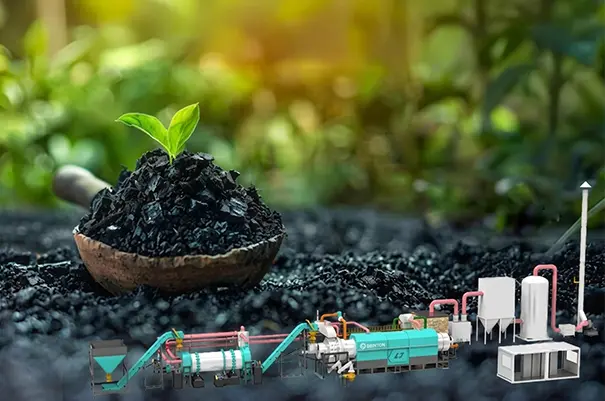
From ancient times to the present, people have never stopped exploring how to make charcoal from wood. From primitive kiln pits, to traditional charcoal kilns, to modern machines, the production of charcoal has become cleaner and more efficient. Today, the use of charcoal making machines has become the mainstream method of producing charcoal, which not only improves production efficiency, but also significantly reduces the impact on the environment. This article will take you to explore how to make wood charcoal through this cutting-edge production method.

Preparation Before Making Charcoal from Wood
Factory Site Selection & Construction
Machine Procurement & Installation
Operation Team Employment
Raw Material Supply

Site Selection
- Geographic Location: Choose a location with convenient transportation, close to raw material supply and market.
- Environmental Conditions: Consider local climate, geological conditions and environmental protection requirements.
- Laws & Regulations: Ensure that the site selection complies with local land use planning and environmental protection laws and regulations.
Infrastructure Construction
- Land Acquisition: Purchase or lease land and handle relevant procedures.
- Factory Layout: Design and build production plants, warehouses and office facilities.
- Public Facilities: Build infrastructure such as water/electricity/gas supply, roads and sewage.

Machine Selection
- Charcoal Machine: Select wood charcoal machine from different production modes, such as batch or continuous.
- Auxiliary Equipment: Purchase raw material pretreatment equipment, such as a dryer, crusher, and roller screening machine.
- Environmental Facilities: Adopt waste gas treatment equipment, water treatment equipment and other facilities.
Machine Installation
- Installation & Commissioning: Hire professional technicians to install, commission and trial production of equipment.
- Operation Training: Provide equipment operation, maintenance and safety training to operators.

- Recruitment Plan: Develop a recruitment plan and recruit required personnel through various channels.
- Position Setting: Planning operators, technical engineers, business managers and management teams and other positions.
- Salary & Benefits: Provide reasonable salary and benefits according to local market levels and economic conditions.
- Skill Training: Provide professional skills training for new employees to ensure that they are competent for the job.

Wood Collection
- Legal Source: Ensure wood source is legal and complies with forest management and environmental regulations.
- Collection Plan: You can directly recycle or purchase waste wood, such as forest waste, sawdust, wood chips, used furniture, etc.
- Supplier Selection: Select reliable wood suppliers to ensure wood quality and supply stability.
Supply Chain Management
- Inventory Management: Establish a wood and wood charcoal inventory management system to optimize inventory levels.
- Logistics Management: Arrange an efficient logistics and transportation system to ensure that wood is in place and wood charcoal is shipped in time.
Wood Biochar Machine with Puro.earth & Isometric Certifications: Maximizing Production Value
Beston Group’s wood biochar machine has successfully passed the rigorous assessments of both Puro.earth (BST-50S Model) and Isometric (BST-50 Model), two of the world’s leading carbon removal platforms. These prestigious milestones validate that our biochar pyrolysis process adheres to the strictest global sustainability standards, offering investors certified carbon credit entry.
Eco-friendly & Compliant Production
- Sustainable feedstock: Utilizing forestry waste or recycled wood from sustainably managed sources to preserve forest resources.
- Minimal emissions: Advanced exhaust gas treatment and syngas recycling systems significantly lower carbon emissions and ensure compliant, low-energy operations.

EBC-Grade Biochar Quality
By precisely controlling key pyrolysis parameters, our biochar machine produces premium biochar that meets European Biochar Certificate (EBC) standards. This ensures high-stability carbon sequestration, making the end product highly valuable for long-term carbon removal applications.

Accelerated Carbon Trading Access
With dual validation from Puro.earth and Isometric, enterprises utilizing Beston technology can seamlessly tap into the high-premium Carbon Dioxide Removal (CDR) market. This dual-certified compliance simplifies the issuance of high-value carbon credits, significantly boosting the ROI of your resource recovery project.
How to Make Charcoal from Wood: Breaking Down the Stages
01 Pretreatment of Wood
Before charcoal production, pretreatment of wood is necessary, including drying, crushing and screening:
- Drying: Remove excess moisture from the outside of the wood through a dryer. The best moisture content is 15%.
- Crushing: Crusher the wood into a size suitable for subsequent processing. The best size is 8mm-12mm.
- Screening: Remove particles that are too small or too small in the wood through a drum screen. This avoids dust blocking the pipeline.
02 Pyrolysis of Wood
The process involves a controlled reduction reaction of wood in an oxygen-deficient state in a closed container. Lignin, cellulose, and hemicellulose in the wood undergo the following reactions in charcoal machine:
- The moisture inside the wood is released at a lower temperature to reduce the moisture content of the wood.
- As the temperature rises to about 250°C, the lignin in the wood begins to undergo demethylation reactions, and when further heated to 280°C, these reactions release heat and accelerate.
- At a high temperature of about 450°C, the aromatic ring compounds generated in the previous stage begin complex reactions such as pyrolysis, dehydrogenation, condensation and hydrogenation.
These cross-cutting chemical changes cause the wood to gradually transform into charcoal, releasing gaseous and liquid byproducts.
03 Recovery of Combustible Gas
04 Collection of Wood Charcoal
Strategies for Getting High-quality Charcoal Made from Wood
Wood Quality Control
Choose the wood species suitable for making charcoal, such as oak, beech, hazel, etc. These woods usually have high carbon content and low ash content. Keep the wood in a dry environment during transportation and storage to control the humidity of the wood and prevent mildew.
Key Data Measurement
Strictly control the key indicators of wood size, moisture content, fluidity, etc. before production. Regularly test and analyze the parameters of finished charcoal, such as carbon content, ash content, calorific value, etc. Ensure that the measured data meets the optimal reaction conditions.
Reaction Parameter Adjustment
Real-time monitoring of the core parameters of the wood pyrolysis process, such as reaction temperature, reaction time, and combustible gas air volume. Timely adjust various parameters to ensure the stability of the biomass pyrolysis plant operation. This ensures the consistency of charcoal quality.
Wood Charcoal Protection
Collect charcoal after cooling down to prevent spontaneous combustion. Charcoal is not in contact with dust when it is discharged from the carbonization furnace to reduce the impurity content. The storage area of wood charcoal is well ventilated to prevent charcoal from absorbing moisture or mildew.
FAQs of Making Charcoal from Wood
01What happens if the wood material is crushed too small (under 5mm)?
02What is the carbonization reaction time for wood chips inside the reactor?
03What is the pressure inside the reactor during the operation of the biochar machine?
04Is the interior of the biochar reactor sealed to prevent air from entering?
- Feeding port seal: Secured by a rotary airlock feeder.
- Discharging end seal: Secured by a water-cooled screw conveyor paired with a discharge airlock.
- Advanced sealing materials: The system utilizes a multi-layer combination including fish-scale plates, graphite blocks, ceramic fiber ropes, sealing cloth, and aluminum foil cloth.
05What is the average yield or output ratio of charcoal from wood?
06To prevent biochar from catching fire, do you provide equipment such as water spraying or sealed storage for the discharged charcoal?
07Do you have any solutions or recommendations for waste heat recovery (e.g., heating or drying)?
- Material drying: High-temperature furnace flue gas is directly routed to the dryer.
- On-site heat recovery: Surplus syngas is directed to an adjacent combustion chamber for immediate combustion, avoiding pipeline clogging from tar condensation.
- Thermal utilization: Clean heat from the combustion chamber can be integrated with heat exchangers to generate hot water or hot air for other plant uses.
08Will the wood carbonization process produce air pollution or black smoke?
- System design: Fully Sealed & Micro-negative Pressure (Prevents gas leaks).
- Standard de-dusting system: Includes a Water Spray Tower and Cyclone Dust Collector.
- Environmental compliance: Flue gas emissions comply with European and international environmental standards.
Obtain “How to Make Wood Charcoal” Solution from Beston Group
In summary, the modern wood charcoal production process can not only maximize the quality of charcoal. It can also achieve efficient use of resources. If you are more interested in how to make wood charcoal or need professional equipment support, please contact Beston Group. We will provide you with the best wood to charcoal solution to help you achieve the goal of efficient and environmentally friendly charcoal production. You can follow us on Facebook to get more information about making charcoal from wood.