Industry Status
- Equipment blockage and frequent interruptions make it difficult to achieve scale profitability.
- Low thermal energy utilization and high energy consumption drive up fuel and running costs.
- Difficult to meet emission standards, facing compliance difficulties and fine risks.
- Frequent manual intervention results in high labor costs and low efficiency.
- The quality of oil & carbon black varies, affecting sales prices.
Why Upgrade P30
It recycles 6,000 tons plastic, 10,000 tons tyres and 12,000 tons oil sludge annually, contributing to both sustainable development goals and stable profitability.
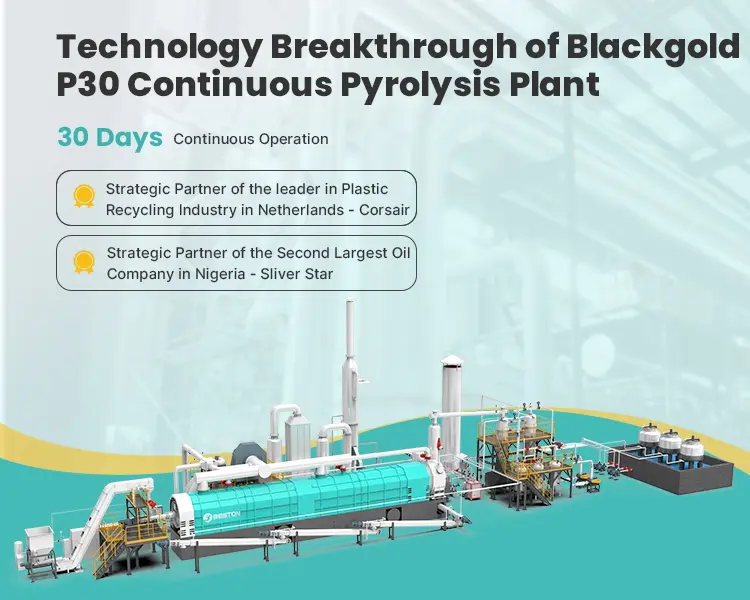
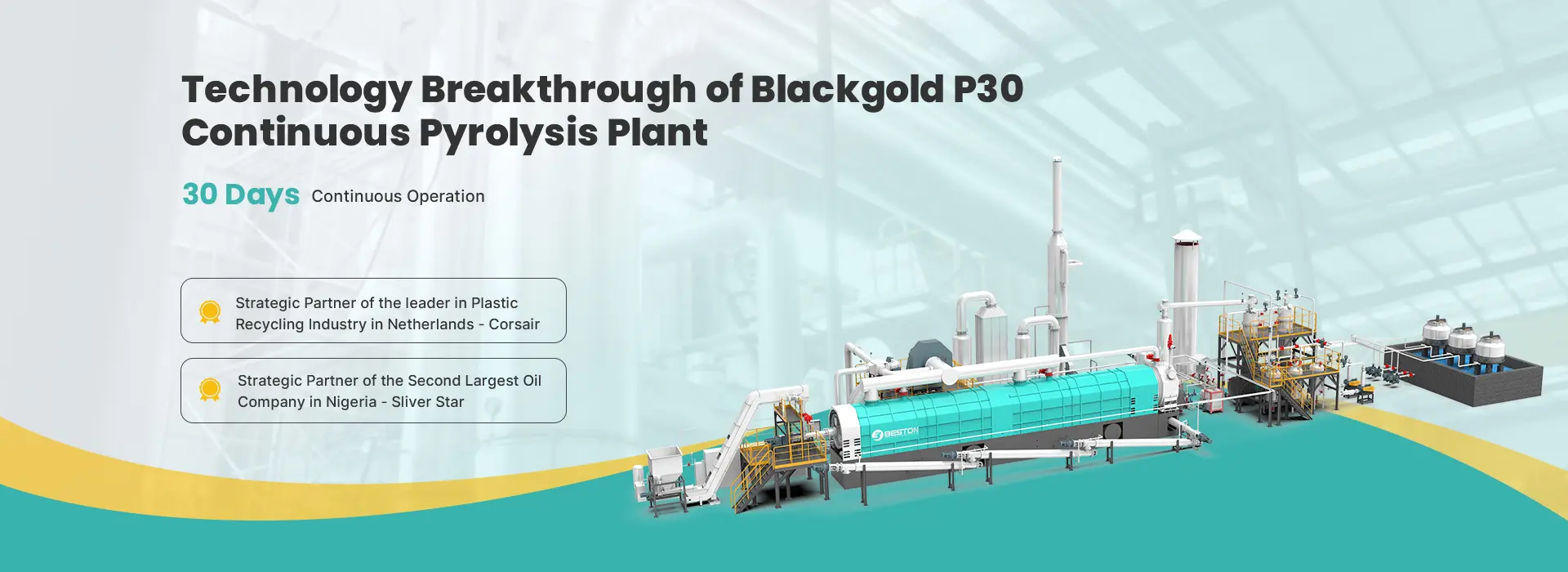
- 30 days of continuous non-blocking operation, no more downtime
- Energy consumption reduced by 55%, significantly reducing fuel costs
- Exhaust emissions reduced by 50%, meeting EU emission standards
- Fully automated process, only 4 workers required, efficiency increased by 60%
- Oil fractionation system and ±10℃ precise temperature control, get high quality light oil, non-standard diesel & carbon black
5 Innovative Technology Modules of Blackgold P30 Continuous Pyrolysis Plant
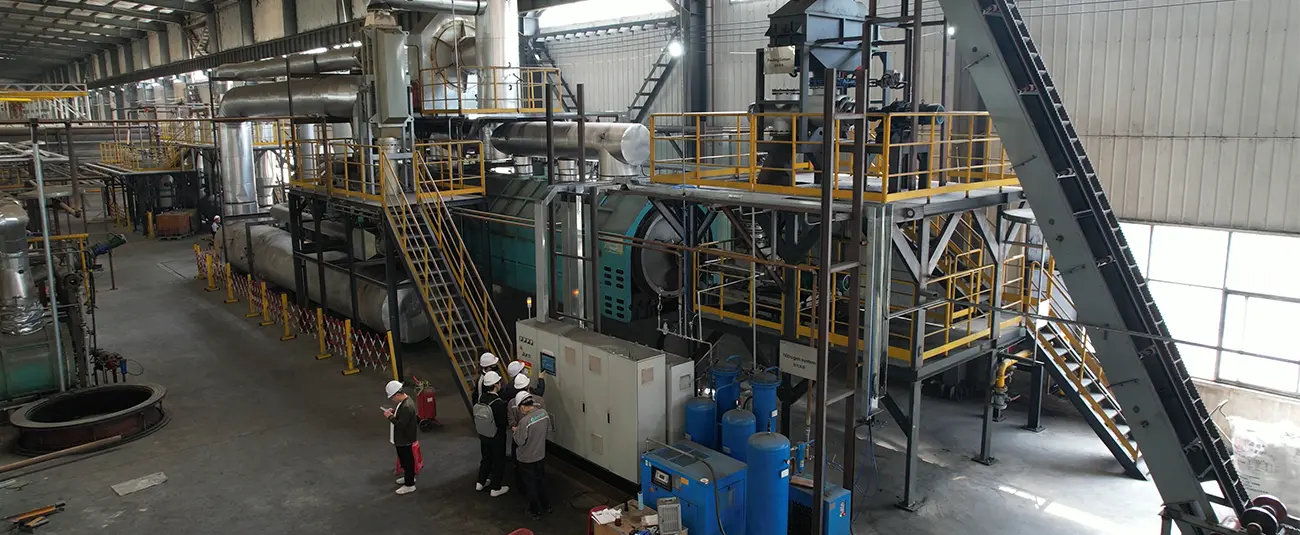
Intelligent Wax Collection System
Combines steam-heated precise temperature control wax-liquefaction technology with a co-current self-cleaning system for liquefied oil. It completely solves pulp clogging, 100% prevents shutdowns for clogging.
Mechanical Decoking Structure
Utilizes mechanical gravity-friction technology and a uniform hot-air heating design to minimize reactor coking. This ensures high thermal efficiency, minimizes decoking downtime, and guarantees continuous operation for up to 720 hours.
Full-Process Automation System
Integrates multi-medium counter-current hot-air heating (±10℃ accuracy), auto-weighing feeding, fractional condensation, and auto-weighing slag discharge. Features IoT remote monitoring and data logging for stable operation.
Light & Heavy Oil Fractionation System
Achieves direct fraction cutting of light and heavy components based on an oil-gas spray system. Maximizes high-value utilization of separated oil without requiring secondary distillation equipment.
Self-Adjusting Sealing Design
Adopts a self-adjusting mechanical design that enables automatic sealing based on varying thermal deformation, combined with nitrogen sealing technology. Ensures maximum operational safety and stability with dynamic seal pressure resistance up to 3kPa.
Convert Plastic/Tyre/Oil Sludge to Value – P30 Continuous Pyrolysis Plant
With large capacity and stability, fully automatic pyrolysis plant is ideal for industrial-scale plastic & tire recycling. The following are specific recyclable raw materials and pyrolysis products:

Acceptable plastics types: PP, PE, PS, and others without chlorine and oxygen (Note: PET/PVC can not be pyrolyzed)
Pyrolysis products: Pyrolysis oil, industrial residue (including a small amount of carbon black), syngas

Acceptable tyres types: Passenger tires, commercial tires, OTR tires, etc.
Pyrolysis products: Pyrolysis oil, carbon black, steel wire, syngas

Acceptable oil sludge types: Landing oil sludge
Pyrolysis products: Pyrolysis oil, industrial residue, syngas
Diverse Applications of Pyrolysis Products

Pyrolysis oil
 Pyrolysis oil can be used as fuel in kilns, furnaces, and boilers for factories with high energy consumption.
 Pyrolysis oil can be processed into non-standard diesel, which can be used in heavy oil generators and heavy machinery engines.
 Pyrolysis oil can also be processed into naphtha, which is used in plastic manufacturing, as a solvent, and as a gasoline blending component.
rCB
 Carbon black can be directly used in the production of cement, asphalt, inks, coatings, and other industrial materials.
 The rCB (Recovered Carbon Black), kind of eco-friendly material is a key ingredient in the manufacture of eco-friendly tires.

Parameter of Blackgold P30 Continuous Pyrolysis Equipment
| Model | Blackgold P30 |
|---|---|
| Manufacturer | BESTON |
| Time to Market | 2026 |
| Motor Brand | Chinese brand |
| Suitable Raw Materials | Waste plastics; Tires; Oil sludge |
| Input Capacity (Max.) | Waste plastic pellets: 0.8-1.05t/h; Rubber powder: 1.25-1.5t/h; Oil sludge:1.8-2.3t/h |
| Working Method | Fully Continuous |
| Final Oil Quality | Pyrolysis oil; Pyrolysis oil with wax or light oil; Gasoline blending components |
| Reactor Material | 304/310S Stainless steel |
| Reactor Life Span (Years) | 5-8 Years |
| Guarantee (Months) | 12 |
| Delivery Time (Calendar Days) | 60-90 |
| Land Space Required (L*W*H*m) | 50*20*10 |
| Packing | 20*6*3m in bulk+13*40HQ |
| Installation Period (Calendar Days) | 60-90 |
Technological Highlights of Black Gold P30 Continuous Pyrolysis Plant
Double Anti-Coking Protection
- Coking Intervention: Hot air heating ensures uniform heat distribution in the reactor, preventing uneven heating and coking.
- Mechanical De-coking: The decoking chain cleans the inner wall of the pyrolysis reactor directly by friction, preventing coking.
Sealing Protection
- Main Furnace Sealing: Combined high-temperature flexible dynamic sealing technology greatly enhances sealing performance of reactor of fully continuous pyrolysis plant.
- Discharge Sealing: The slag tank is equipped with a material seal to prevent leakage of high-temperature oil and gas during continuous slag discharge.
Precise & Safe Feeding
- “Gram” Level Weighing: Electronic weighing system not only control the feed amount to the “gram” level but also allow real-time monitoring and phase statistics.
- Oxygen-Deficient Protection: Nitrogen generator over 95% purity replaces the air in the sealed silo, maintaining an oxygen-deficient environment inside the reactor.
EU Emission Standards
- Chemical Treatment: Exhaust gas flows into an SCR denitration tower to eliminate NOₓ. Then it proceeds to a desulfurization tower to eliminate sulfur compounds.
- Physical Treatment: Exhaust gas passes through electrostatic precipitator to remove large particulates. Finally, it enters activated carbon device to adsorb fine particulates.
Benchmark Project of Pyrolysis Plant

Plastic Pyrolysis Project in Morocco
– Fuel Cost Reduction
Project Goals
- Obtain pyrolysis oil: Convert waste plastics into fuel oil;
- Cut energy costs: Power the factory with the oil to cut energy costs;
- Stable operation: Ensure stable operation for long-term gains.
Project Status
Development Started 2024 | Installation Completed | Operating
Project Outcomes
- High oil yield: Continuously convert plastic into fuel oil, the oil yield achieves approximately 65%.
- Reduce production costs: Use the obtained pyrolysis oil instead of diesel, greatly reducing production costs.

Pyrolysis Project in North Africa
– Solves Oil Sludge Treatment Challenge
Project Goals
- Project Compliance: Meet AU and local emission standards through sludge pyrolysis process. Obtain project EIA certification.
- Cost Reduction: Self-built treatment center improves oil sludge treatment capacity, significantly reducing costs.
Project Status
Development Started 2024 | Installation Completed | Operating
Project Outcomes
- Emissions Meet Standards: The treated oil sludge fully meets AU and local environmental protection standards.
- Improved Processing Capacity: After the equipment is put into operation, large-scale processing capacity is stably guaranteed.
- ROI Improvement: Reduce external processing expenses, obtain sales revenue of pyrolysis products, and improve ROI.

Pyrolysis Project in the Netherlands
– Build a Greener Plastics Value Chain
Project Goals
- Achieve large-scale plastic recycling and promote EU circular economy.
- Meet stringent NOx emission standards.
- Solve the risk of wax oil clogging machine in pyrolysis
Project Status
Development Started 2023 | Installation Completed | Operating
Project Outcomes
- Equipment is operating smoothly with no blockages, minimal downtime.
- Annually recycle 24,000 tons of plastic waste, and reduce 93,000 tons of CO₂ emissions.
- Supply pyrolysis oil for new plastic production, enabling a true circular economy.
Workflow of P30 Continuous Pyrolysis Machine
Beston Group provides an on-site demonstration video to help you better understand the components and operational process of the P30 equipment.
01 Feeding
- The first screw feeder conveys raw materials in a silo to the weighing machine for precise weighing.
- The second screw feeder then delivers the accurately quantitative material into the pyrolysis reactor.
02 Pyrolysis
- The raw materials enter the reactor of continuous pyrolysis plant. Then, under the push of guide plate, the raw materials are fully heated from the front to the back.
- When the temperature reaches 180 degrees Celsius, gas oil begins to generate. A significant amount of gas oil appears at temperatures between 280-350 degrees Celsius.
03 Catalytic(only for plastic)
04 Condensation – Light & Heavy Oil Formation
- Light oil: The light oil gas will be liquefied into fuel oil (can be refined to naphtha) by the condenser and reserved in the fuel oil tank.
- Non-standard diesel (heavy oil): The oil gas enters the manifold of continuous pyrolysis plant, and heavy particles of the oil gas will be liquefied and dropped into the heavy oil tank.
05 Gas Recovery & Utilization
- Non-condensable gas is directed to the buffer tank, water-gas separator and multiple water seals to stabilize the gas pressure.
- The purified combustible gas is recovered and returned to the combustion chamber for combustion to produce hot air.
- Part of high-temperature flue gas is directed to the combustion chamber. It mixes with the hot air and heats the reactor.
- The remaining flue gas exchanges heat with the air in the air-to-air heat exchanger. The heated air provides oxygen to support closed combustion.
06 Discharge
- The residue is transported to the water-cooled slag box through the spiral slag discharger at the tail of the continuous waste plastic pyrolysis plant reactor.
- Soild residue in storage tank enters multiple water-cooled slag dischargers for cooling.
- Sampler is deployed at the tail of the reactor. Operators can periodically sample the slag to monitor its condition.
07 Exhaust Gas Treatment
Stay Ahead of Policy Trends: Choose Continuous Pyrolysis Plant First
As global environmental regulations tighten, governments worldwide are driving industries toward greener, more efficient, and sustainable development. Continuous pyrolysis equipment stands out as the smart choice, especially when considering the following policy trends:

Government Bans
Many countries are phasing out traditional batch systems due to their pollution and safety risks. For example, in 2023, China’s State Council mandated the complete phase-out of non-compliant fixed-bed batch gasifiers. Continuous systems, featuring closed-loop operation and fully automated control, are cleaner, safer, and more likely to meet future regulatory standards.

Policy Incentives
Governments offer subsidies, tax breaks, and green financing for advanced, low-emission equipment. Continuous pyrolysis machine qualifies for such support due to their energy efficiency and better emission control, which helps investors reduce costs and attract ESG-driven investment.

Easier Environmental Approval
Environmental Impact Assessments (EIA) and Safety Assessments are easier to pass with continuous systems. Their steady-state operation and reliable emission control simplify compliance, speeding up the permit process and reducing project delays.
Contributions of Blackgold P30 Continuous Pyrolysis Equipment to Industries
As global environmental regulations tighten, governments worldwide are driving industries toward greener, more efficient, and sustainable development. Continuous pyrolysis equipment stands out as the smart choice, especially when considering the following policy trends:

Waste Management Recycling Industry
These industries need to manage high volumes of waste plastic or waste tires. By adopting continuous pyrolysis technology, they can:
- Efficient treatment: Large amount of plastics/tyres can be processed by P30 continuous pyrolysis machine. One day, it can process 35 tons tires or 25 tons plastics.
- Qualified carbon black output: Automatic temperature control ensures toluene permeability meets standards, turning carbon black into valuable end product.
Oil and Gas Industry
Faced with substantial volumes of oil sludge, this industry benefits from continuous pyrolysis system in several key ways:
- Waste reduction & harmless:P30 can recycle oil components of waste generated in the industry, reducing waste volume and avoiding environmental risks.
- Enhance industry influence: Investing in cutting-edge recycling technology demonstrates ESG leadership and wins recognition from society and government.


Manufacturing Industries with High Fuel Oil Demand
Heavy industries such as cement, metallurgy, and chemicals are seeking cost-effective and cleaner energy alternatives. Continuous pyrolysis plant offers:
- Energy independence: Convert internal waste or sourced materials into fuel, reducing reliance on external suppliers and cutting fuel expenses.
- Low-cost environmental compliance: EU industries face strict emission standards. Flue gas recirculation and air preheating help meet these requirements while keeping compliance costs down.
Launch Continuous Pyrolysis Project with Beston Group
Invest in a continuous pyrolysis plant and lead the way in cutting-edge solid waste recycling. Designed for profitability, sustainability and industrial-scale operation, it’s the smart choice for large-scale recycling projects. Share your needs, we will provide you with a customized solution. Follow us on Linkedin to stay up with latest innovations.