As climate change intensifies, reducing high-impact greenhouse gas emissions has become a global priority. While carbon dioxide often dominates discussions, other gases with higher global warming potentials (GWPs) pose even greater short-term threats. Addressing these emissions requires innovative solutions – biochar is one of them.
What is Global Warming Potential?

Definition of GWP
Global Warming Potential (GWP) is a scientific index used to compare the ability of different greenhouse gases to trap heat in the atmosphere over a specific time horizon, typically 20, 100, or 500 years. It expresses how much energy one ton of a gas will absorb compared to one ton of carbon dioxide (CO₂), which serves as the baseline with a GWP value of The concept helps scientists and policymakers assess the relative climate impact of various gases and supports carbon accounting, climate modeling, and emissions regulation.
How GWP Is Determined
The GWP of a gas is influenced by three key factors: its radiative efficiency (how strongly it absorbs infrared radiation), its atmospheric lifetime (how long it remains in the atmosphere), and the selected time scale of assessment. A gas that absorbs more heat or persists longer in the atmosphere will have a higher GWP. For example, methane and nitrous oxide have higher GWPs than CO₂ because they are more efficient at trapping heat and have longer-lasting atmospheric effects, even when emitted in smaller quantities.
Which Gases Have High Global Warming Potentials?
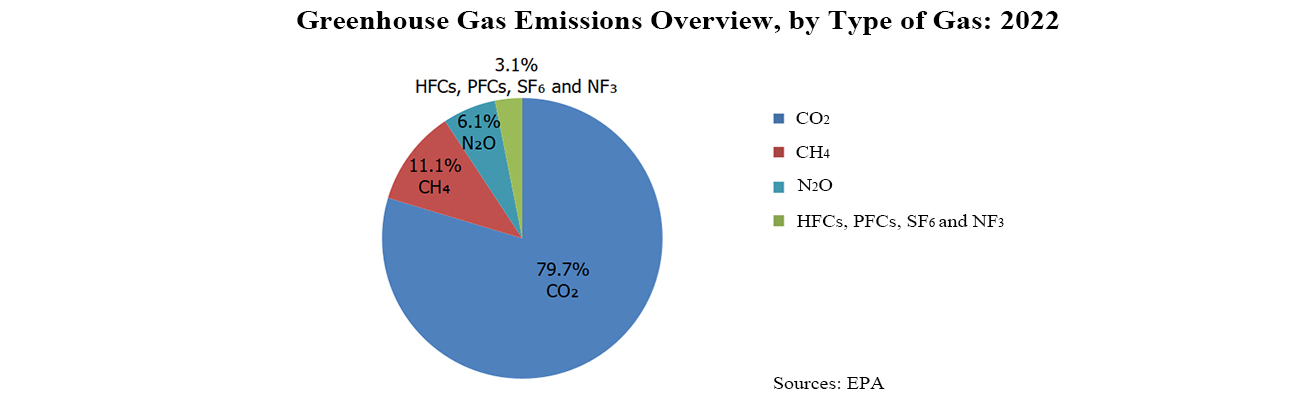
On a global scale, the major greenhouse gases emitted by human activities include carbon dioxide, methane, nitrous oxide, and fluorinated gases (F-gases). The following provides their GWP, sources, and impacts for reference only.
Methane (CH₄)
- GWP: Methane has a GWP of about 30 over a 100-year period, making it 30 times more potent than CO₂ in trapping heat.
- Source: It is mainly released from livestock digestion, rice paddies, landfills, and fossil fuel extraction.
- Influence: Although methane has a shorter atmospheric lifespan than CO₂, it causes intense short-term warming and contributes to ground-level ozone formation, which harms air quality and crop yields.
Nitrous Oxide (N₂O)
- GWP: Nitrous oxide carries a much higher GWP of approximately 273, meaning it is 273 times stronger than CO₂ at trapping heat.
- Source: Its primary sources include nitrogen-based fertilisers, manure management, biomass burning, and some industrial processes.
- Influence: Besides warming the planet, N₂O also depletes the stratospheric ozone layer, posing risks to human health and ecosystems.
Hydrofluorocarbons (HFCs)
- GWP: Hydrofluorocarbons are synthetic gases with GWPs ranging from hundreds to over 7,000 depending on their chemical structure.
- Usage: They are commonly used in refrigeration, air conditioning, foam blowing agents, and aerosols.
- Influence: HFCs are not naturally occurring and persist in the atmosphere for a long time, making them highly damaging to the climate. Even small leaks can cause significant warming due to their very high GWP.
How Biochar Helps Mitigate Greenhouse Gas Emissions
Biochar, produced from biochar production equipment, plays a significant role in reducing high-GWP gas emissions and supporting long-term carbon sequestration. Its climate impact comes from three main mechanisms: preventing gas formation, locking carbon in stable form, and lowering soil-based emissions.

Avoiding CH₄ and N₂O from Organic Waste
When agricultural residues, manure, or forestry waste are landfilled, openly burned, or left to decompose, they generate methane (CH₄) and nitrous oxide (N₂O) through anaerobic microbial activity. These gases have much higher GWP than CO₂. Converting this biomass into biochar instead provides a clean disposal method and avoids the release of these potent greenhouse gases during decomposition.
Long-Term Carbon Sequestration
During pyrolysis, unstable organic matter is transformed into a stable, carbon-rich solid with a highly aromatic structure. When biochar is applied to soil, this carbon is stored in a form that resists microbial breakdown, effectively locking atmospheric CO₂ away for hundreds to thousands of years. This makes biochar a reliable long-term carbon sink.


Reducing Soil-Based Emissions
Biochar enhances soil structure, increases aeration, and improves nutrient retention. These properties reduce nitrogen losses from fertilisers and help suppress the formation of N₂O in cultivated soils. In flooded conditions, such as rice paddies, biochar inhibits methanogenic microbes, reducing CH₄ emissions. Additionally, better soil health promotes plant growth, increasing natural carbon uptake.
GWP in Environmental Remediation: Significance and Biochar’s Role
GWP is essential in environmental remediation because it helps determine which pollutants most strongly influence long-term climate warming. In landfills, degraded farmland, peatlands, and contaminated sites, methane and nitrous oxide are often more damaging than CO₂ due to their high GWP. Biochar-based remediation not only stabilizes heavy metals and improves soil structure but also suppresses microbial activities that generate CH₄ and N₂O, actively reducing the release of high-GWP gases. This means remediation is not just about restoring land quality but also about mitigating climate impact—converting degraded land into carbon sinks rather than emission sources.
Future Outlook: Biochar as a Climate-Positive Remediation Material
Looking ahead, environmental restoration will increasingly shift from merely repairing damaged ecosystems to actively enhancing their carbon removal capacity. Biochar will be recognized not only as a soil enhancer or waste management product, but as a climate remediation material with long-term atmospheric benefits. Its ability to create stable carbon pools in soils aligns with global carbon neutrality strategies and emerging standards for durable carbon removal. As international standards such as Puro.earth, ect., and ISO 14064 evolve to quantify removal permanence, biochar-based restoration initiatives are expected to transition from environmental projects into recognized climate assets with measurable, certifiable climate impact.

Partner with Beston Group to Advance Carbon Reduction with Biochar
Beston Group biochar systems not only transform biomass into stable carbon sinks but also meet stringent GHG emission standards. With ultra-low CH₄ (0.1%) and N₂O (<1%) emissions, our technology supports low-carbon production and regulatory compliance. Together, we can accelerate the transition toward climate-resilient practices and a circular, low-carbon economy.