Behind every carbon credit, you could find a completely different project, a different quantification method, a different verification system. For buyers, checking each one individually is close to impossible. “Is this batch of credits actually any good?” has always been a question the voluntary carbon market can’t avoid. So the Integrity Council for the Voluntary Carbon Market (ICVCM) stepped in and developed the Core Carbon Principles(CCP), to give the market a general standard.
Understanding ICVCM and CCP
Who Is ICVCM?
ICVCM is an independent non-profit that sets a unified quality baseline for the voluntary carbon market. It doesn’t issue carbon credits or develop projects itself. Instead, it assesses the parties that set the rules:
- Carbon-crediting programs: do programs’ rules, governance and registry systems hold up?
- Methodologies: does the methodology’s approach to quantifying emission reductions or removals hold up scientifically?
Note: Following ICVCM terminology, this article uses “program” to refer to carbon crediting registries and standard setters.
What Does CCP Cover?
The CCP label sets a clear quality baseline, allowing buyers to screen out unqualified credits without project-by-project checks. In total, the framework comprises ten principles across three categories:
| Category | Principles |
|---|---|
| Governance | Effective governance; Tracking; Transparency; Robust independent third-party validation and verification |
| Emissions Impact | Additionality; Permanence; Robust quantification; No double counting |
| Sustainable Development | Sustainable development benefits and safeguards; Contribution to net-zero transition |
Two Designations: CCP-Eligible and CCP-Approved
The CCP system carries two distinct designations: one for programs, one for methodologies. The names look similar, but what gets assessed, what gets examined, and what kind of outcome results differ significantly.
| CCP-Eligible | CCP-Approved | |
|---|---|---|
| What’s being assessed | The program itself | A methodology under the program (specific version) |
| The question it answers | Does this program’s operating framework hold up? | Does this reduction/removal quantification method hold up? |
| What’s examined | Governance, transparency, tracking, independent verification, plus program-level quantification and double-counting rules | All ten CCPs, primarily additionality and permanence |
| Version Scope & Boundary | Tied to a specific Program Standard version. Major program updates require re-assessment. | Strictly locked to a specific methodology version . Approval does not automatically apply to earlier or future versions. |
| Possible outcomes | Approved, tied to a specific standard version | Approved / Conditionally approved / Does not meet |
How Does a CCP Label Actually Get “Applied”?
When buyers see a batch of credits carrying the CCP label, they often assume ICVCM issued some kind of “certificate” directly for that batch. In reality, three parties sit between rule-setting and the label showing up, and each handles a different part of the process.
| Party / Actor | Core Function | Role in the CCP System |
|---|---|---|
| ICVCM | The independent quality gatekeeper of the voluntary carbon market; it doesn’t issue credits or develop projects | Assesses whether programs and their methodologies meet CCP and issues approval decisions. It doesn’t assess individual projects or stamp specific credits |
| Carbon credit program | Set project development standards and methodologies, review and register projects, issue carbon credits, and operate the registry that records issuance, transfer and retirement | First undergo ICVCM assessment themselves, then submit their methodologies for assessment one by one. Once approved, the program applies the CCP label to eligible credits |
| Project developers | Choose a program, develop the project under its standards and methodology, and apply for credit issuance after independent third-party verification | Whichever program and methodology the project chooses determines whether the resulting credits have any chance of getting labelled |
In short, ICVCM assesses the rules, the registry applies the label to the credits, and the project developer builds the project according to those rules.
Both Designations Together = Credits Get Labelled
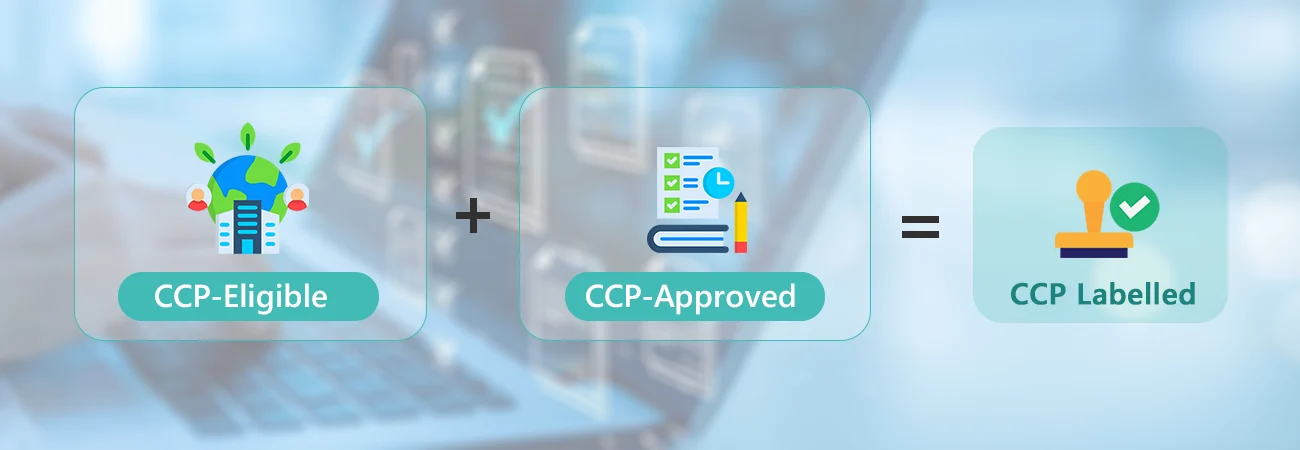
| Program CCP-Eligible | Methodology CCP-Approved | Result |
|---|---|---|
| ✓ (approved version) | ✓ (approved version) | Eligible credits can carry the label |
| ✓ | Not yet assessed or not approved | Cannot be labelled yet |
| ✗ | ✓ | Cannot be labelled |
Program eligibility unlocks methodology assessment. Only credits issued under both an approved methodology and an approved program standard version can earn the CCP label. Moreover, once a methodology gets approved, here’s a separate question: can credits issued before approval, and not yet retired, get a retroactive label? The answer depends on the program’s own rules:
- Some programs label automatically. As soon as the methodology gets approved, the program automatically labels credits issued earlier under it too, with no application needed.
- Others require an optional, paid application. On the contrary, project developers can re-quantify past monitoring data under the new methodology. Once approved, credit holders can then choose to exchange old credits and pay a retroactive labelling fee for new, labelled credits. However, credits that have already been retired can’t get a retroactive label.
How Far Has CCP Actually Gone?
Overall Progress
- 13 CCP-Eligible programs approved to date, with 8 more under assessment.
- 44 total approved methodologies.
- Across the market, roughly 115 million credits are eligible to carry the CCP label.
Biochar Methodology: A Closer Look
As the market for biochar carbon credits scales rapidly, the underlying methodologies are coming under intense ICVCM scrutiny. While project developers race to expand production, commercial viability now depends entirely on whether specific frameworks satisfy the rigorous CCP criteria—transforming technical accounting into a make-or-break milestone.
| Program | Methodology | Status |
|---|---|---|
| CAR | U.S. and Canada Biochar V1.0 | CCP-Approved (August 2025) |
| Isometric | Biochar Production and Storage V1.0 | CCP-Approved (August 2025) |
| Isometric | Biochar Production and Storage V1.1–1.2 | Under assessment, no decision yet |
| Verra | VM0044 V1.0–1.1 | Withdrawn |
| Verra | VM0044 V1.2 | CCP-Approved (August 2025) |
| Puro.earth | Biochar Methodology 2022 V3.0 | Withdrawn |
| Puro.earth | Biochar Methodology 2025 V2.0 | Under assessment, no decision yet |
| Rainbow | Distributed closed-kiln / open-kiln biochar V1.0 | Under assessment, no decision yet |
What CCP Means for Different Players in the CDR Industry

1. For Carbon Removal Registries
- The New Minimum Standard: CCP isn’t a nice-to-have bonus anymore. If a registry stays out of the assessment process, buyers will simply view its credits as second-tier, forcing the registry to compete purely on price discounts.
- First-Mover Advantage in Methodologies: The real competition is about who gets their CDR methodologies cleared first. Registries that get biochar, DAC, or other removal pathways approved early will lock in corporate buyers who aren’t willing to gamble on unapproved methods.

2. For Carbon Removal Project Developers
- De-risking Forward Offtakes: CDR projects take serious upfront capital, and developers usually rely on buyers signing long-term pre-purchases before construction starts. A CCP label gives corporate legal and procurement teams the green light to sign those deals without hesitation.
- Choosing the Right Methodology: If you choose a methodology that has been shelved or rejected by the ICVCM, you will face a difficult sales process. Even if your engineering is flawless, you’ll end up stuck in a smaller buyer pool with far less pricing power.

3. For Carbon Removal Credits Buyers
- Outsourced Due Diligence: Most corporate sustainability teams don’t have the engineering capacity to audit a 100-page biochar or DAC methodology from scratch. The CCP label acts as a reliable pre-filter, letting buyers skip basic rulebook checks and focus on evaluating the actual projects.
- A Shield Against Greenwashing Claims: As disclosure laws like the EU CSRD take effect, buying “independently assessed” credits is no longer just about public relations — it gives legal teams a solid, defensible position if anyone challenges their climate claims.
The Baseline Shift in High-Integrity Carbon Credits
The CCP label is not a substitute for project-level due diligence. In fact, it is the baseline filter that separates institutional-grade credits from the rest. As the ICVCM assessment pipeline matures, compliance is shifting from a marketing advantage to a market entry requirement. For registries, developers, and buyers alike, navigating this transition demands absolute precision—verifying program status, methodology versions, and registry alignment before capital moves.