Biochar carbon removal offers a durable solution to reduce atmospheric CO₂ by stabilizing biomass carbon through pyrolysis. This approach sequesters carbon in solid form for centuries while generating verifiable carbon credits. As voluntary carbon markets expand and compliance frameworks begin to emerge, biochar projects gain increasing attention from investors, corporations, and policymakers seeking scalable, long-term biochar CDR solutions.
What Is Biochar and How Is It Made?
Biochar is a stable, carbon-rich material produced by heating biomass under limited or no oxygen, a process called pyrolysis. Biochar resists decomposition, enabling long-term carbon sequestration. The production process involves several stages using specialized biochar machine:
- Feedstock Treatment: Crush, dry, and remove impurities from biomass.
- Pyrolysis Reaction: Heat biomass under low-oxygen conditions to produce biochar, combustible gas, and liquid by-products.
- Energy Recovery: Recover combustible gas, and liquid by-products to fuel the pyrolysis system.
- Biochar Collection: Cool and collect high-temperature biochar.
How Biochar Achieves Durable Carbon Removal
Most agricultural and forestry biomass is processed through decomposition or incineration. Within years, or even hours, CO2 fixed through photosynthesis is released back into the atmosphere. The core of biochar carbon removal lies in intervening in this short-term carbon cycle by pyrolyzing biomass into chemically inert solid carbon. As biochar carbon sequestration is stable for centuries in suitable environments, it meets climate assessment benchmarks and provides truly durable carbon removal.
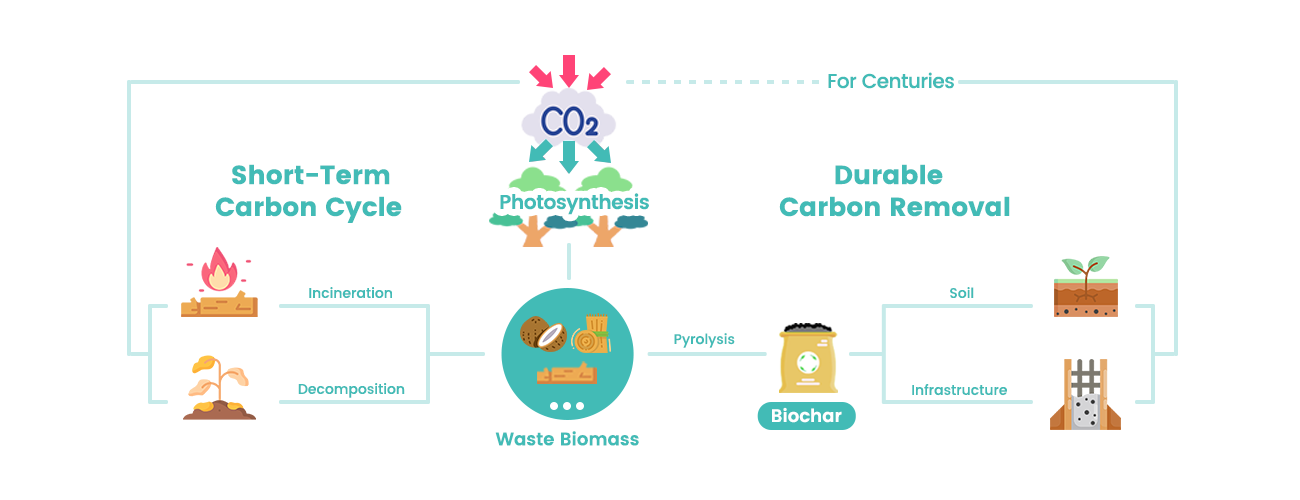
Short-Term Carbon Cycle
- Carbon Trajectory: Atmosphere → Plants → Waste Biomass → Atmosphere
- Temporal Scale: From hours to several decades
- Atmospheric Impact: Dynamic equilibrium. Emissions and absorption occur on similar timescales, so the long-term atmospheric CO₂ concentration remains largely unchanged.
Durable Carbon Removal
- Carbon Trajectory: Atmosphere → Plants → Waste Biomass → Biochar → Stable Environment → Atmosphere
- Temporal Scale: Hundreds to thousands of years
- Climate Impact: Net negative emissions. On a century-scale climate assessment, carbon is effectively removed from the atmospheric cycle and substantially reduces atmospheric carbon stock.
Biochar Carbon Removal: A Core Pillar of the CDR Market
Carbon Dioxide Removal (CDR) market connects carbon removal project owners with voluntary carbon credits buyers. This marketplace provides a transparent channel for carbon credit trading.
Carbon credit is a tradable unit granted for removing a specific amount of CO₂, with each credit representing one ton of CO₂ removed. The lifecycle of a carbon removal credit consists issuance, delivery and retirement.

Market Size
- Transaction Volume: Biochar carbon credit trading grew from $14.6 million in 2022 to $181.5 million in 2024. This represents a compound annual growth rate (CAGR) of 131.6%.
- Delivery Volume: From Q1 2022 to H1 2025, the total contracted biochar carbon removal volume reached 3.04 million tons. Of this, the cumulative delivered volume reached 658,000 tons.

Industry Leadership
- Delivery Share: In 2024, biochar CDR deliveries accounted for 86% of the total global CDR deliveries. From 2020 to 2024, the cumulative share was 83%.
- Number of Buyers: Biochar carbon credits had nearly 300 independent buyers, which is five times more than any other carbon removal method.

Regional Characteristics
- Suppliers: The top four global suppliers all come from the Global South, together holding 74% of the industry share. Notably, the Bolivian supplier Exomad Green secured the largest-ever order in 2025, providing a million-ton contract to Microsoft.
- Purchasers: The market heavily relies on key buyers. The United States alone accounts for 68% of purchases. Microsoft, Google, BCG, and JPMorgan together covered 57% of global transactions.
Data source: CDR.fyi, as of Q1 2025.
Key Factors for Deploying Biochar CDR Projects
As transaction volumes and project numbers for biochar CDR grow rapidly, more investors are entering this space. However, understanding biochar’s value in the CDR market is only the first step. The more critical question is how a biochar carbon removal project can consistently deliver verifiable carbon removal credits over time.
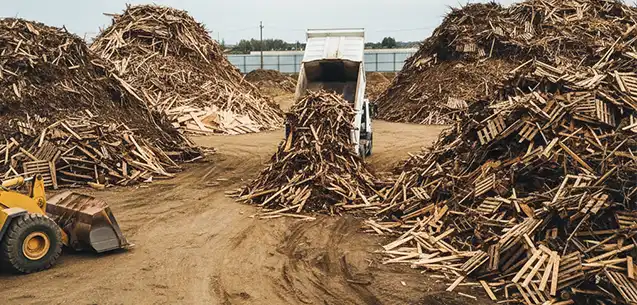
Feedstock Supply
- Compliance & Traceability: Feedstock should meet compliance such as Land-use Change (LUC) . Also, traceability certifications such as Forest Stewardship Council (FSC) is need.
- Carbon Leakage Control: Focus on local or regional waste biomass. Limit transportation distances to prevent logistics-related emissions from reducing net carbon removal.
- Supply Stability: Establish mid- to long-term supply agreements and build a reliable supply chain. This reduces feedstock volatility and supports continuous operation.
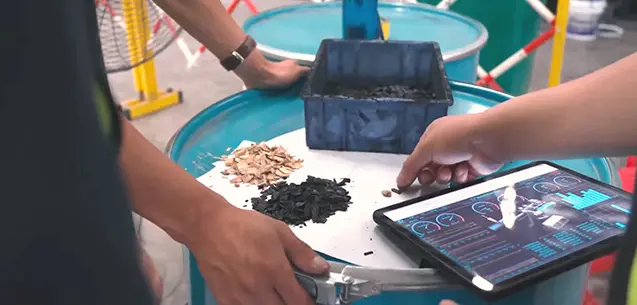
Facility Selection & Operations
- Process Compatibility: Select pyrolysis machine that match the feedstock type, production scale, and site conditions. Ensure project operates stably under compliant conditions.
- Operational Cost Control: Maintain controllable energy, labor, and maintenance costs to protect the long-term economic viability of the carbon removal project.
- Operational Reliability: Monitor and adjust key process parameters online. This ensures consistent fixed carbon content and structural characteristics of the produced biochar.

dMRV System Integration
- Data Source Locking: Use GPS, IoT sensors, and automated metering to capture source data at each stage. This prevents manual tampering or post-hoc data entry.
- Emission Data Coverage: Implement online monitoring and automatic logging to capture energy use and process emissions. This ensures complete data for lifecycle assessment (LCA).
- Standardized Verification: Process and monitoring data should follow the carbon removal methodology requirements. Integration with verification agencies can be achieved via APIs or data interfaces.

Certification & Credit Trading
- Certification Requirements: Projects must follow the biochar carbon removal methodology, align with the process pathway and application scenario, and maintain third-party auditing and continuous monitoring.
- Ongoing Compliance: Projects undergo periodic verification and reassessment during operations. This ensures continued compliance and avoids credit invalidation or retroactive risk.
- Credit Trading Pathways: Biochar carbon credits should be traded through CDR marketplaces or long-term purchase agreements. Biochar carbon credits price depends on market supply and credit quality.
Global Policy Signals for Biochar Carbon Removal
As carbon removal markets mature, voluntary credits are increasingly complemented by emerging compliance frameworks. Biochar CDR projects now face growing policy signals that aim to standardize, regulate, and incentivize long-term carbon removal.

EU
US
Brazil
India
EU CRCF (Carbon Removal Certification Framework)
As of 2025, the EU CRCF has been formally adopted and entered into force. It establishes the EU’s first bloc-wide voluntary system for certifying carbon removals and carbon farming. The European Commission is finalizing implementing rules and certification methodologies. Full operational rollout is expected through 2026. The framework remains voluntary and is not yet part of the EU Emissions Trading System (EU ETS).
Impact on Biochar CDR Projects:
Biochar carbon removal projects can obtain official certification under CRCF. This improves the transparency and comparability of carbon credits. It also supports access to the EU voluntary market and international markets. By promoting standardized methodologies and monitoring requirements, the framework strengthens investor confidence and encourages participation in high-quality biochar CDR projects.
Policy Stage & Limitations:
CRCF reached legislative negotiation and adoption between 2024 and 2025. Next steps include implementing the regulation and developing delegated acts that define detailed methodologies and execution rules. Currently, it operates as a voluntary certification system and is not recognized as a compliance offset under the EU ETS. Investors should monitor the release of final methodologies and certification procedures.
Learn More
US 45Q Tax Credit
The US federal government provides long-term tax credits for carbon capture and storage (CCS) and carbon removal under the Inflation Reduction Act. The 45Q tax credit offers a fixed credit for each ton of CO₂ successfully captured and permanently stored. The credit amount varies depending on the storage method, including geological storage, product utilization, or permanent sequestration.
Impact on Biochar CDR Projects:
Biochar enables long-term carbon storage through pyrolysis-based biochar carbon capture. This qualifies projects for 45Q tax credits. As a result, projects gain stable cash flows from tax incentives. This policy increases investment attractiveness, reduces upfront capital and operational barriers, and improves long-term project economics.
Policy Stage & Limitations:
The 45Q credit is a long-term federal incentive. Credit amounts and eligibility may change with future policy updates. Projects must provide verification, monitoring, and long-term storage documentation, ensuring data traceability and methodological compliance.
Learn More
Brazil SBCE (Sistema Brasileiro de Comércio de Emissões de Gases de Efeito Estufa)
Brazil legislated the SBCE in 2024, introducing a compliance carbon market based on cap-and-trade. Emission allowances and certified reduction/removal credits enter institutionalized trading. This framework provides a pathway for biochar carbon removal to generate tradable credits, creating policy-driven incentives for long-term carbon removal.
Impact on Biochar CDR Projects:
Carbon removal credits verified under approved methodologies can trade in the compliance market. Companies can use them for emission compliance or trading. This provides a domestic compliance market foundation for biochar carbon removal pathways.
Policy Stage & Limitations:
Brazil approved the SBCE legislation, but authorities are still developing mechanisms, emission baselines, and trading platforms. Full implementation will be gradual, and rules for non-traditional projects like biochar remain unclear. Developers should follow upcoming guidance.
Learn More
India CCTS (Carbon Credit Trading Scheme)
In 2025, the Indian government officially announced the CCTS framework. It establishes a national carbon credit trading system with both compliance and offset pathways. The compliance pathway sets emission intensity targets for specific industries. Companies meeting these targets receive carbon credits. The offset pathway allows carbon removal projects, including biochar, to register and generate credits.
Impact on Biochar CDR Projects:
CCTS provides an officially recognized pathway for long-term biochar carbon credits. This gives biochar projects potential policy support and trading channels in the domestic market. The framework also promotes standardization and institutionalization of carbon credits, boosting credit credibility and participant confidence.
Policy Stage & Limitations:
CCTS derives legal authority from the 2022 Energy Conservation Act amendment. India announced the framework in 2025 and began implementation preparations. Covered industries, emission baselines, and compliance rules remain under development, and biochar projects’ use and credit fulfillment depend on forthcoming regulations.
Learn More
Partner With Beston Group
Biochar carbon removal has become a mature carbon removal pathway. The efficiency of a Biochar CDR project in acquiring high-value carbon credits increasingly depends on technological reliability, dMRV integration, and compliance adaptability. Beston Group supports the implementation of Biochar CDR projects through end-to-end support, industrial-scale biochar machine, and professional engineering experience. Let us help you transform the carbon sequestration potential of biochar into verifiable and profitable long-term results.