The history of the oil industry is more than just a story of energy production; it is a history of painful environmental lessons. For decades, dealing with oil waste was ignored or simply hidden away. However, two major disasters changed everything: the 1989 Exxon Valdez oil spill in Alaska and the 2010 Deepwater Horizon accident in the Gulf of Mexico. These events forced the world to rewrite environmental laws, improve how we clean up polluted coastlines, and set much higher standards for treating oil sludge.
1989: The Exxon Valdez Oil Spill in Alaska, USA


The Incident
On March 24, 1989, the oil tanker Exxon Valdez struck Bligh Reef in Alaska’s Prince William Sound. The collision tore open the hull, releasing approximately 11 million gallons (roughly 42,000 cubic meters) of crude oil into one of the most pristine and biologically diverse marine ecosystems on Earth. The remote location and delayed response allowed the slick to spread across 1,300 miles of coastline.
Environmental and Economic Impact
The impact was devastating. Hundreds of thousands of seabirds, thousands of sea otters, and countless fish perished. Beyond the immediate biological carnage, the spill crippled the local fishing and tourism industries. Even decades later, pockets of fresh oil remain trapped beneath the boulders of Alaskan beaches, proving that oil pollution does not simply go away with time.
Remediation and Recovery Efforts
The cleanup was a massive field experiment divided into two primary fronts:
- Offshore operations: To prevent the oil from spreading, workers deployed aerial dispersants to break down oil, utilized mechanical skimmers and booms for physical recovery, or simply burned it off the surface.
- Shoreline cleanup: Given the rocky inlets of Prince William Sound, crews used high-pressure hot water to scrub oil from stones. While visually effective, this heat sterilized the rocks, killing the indigenous microbes that naturally degrade hydrocarbons.
Legal Transformation: OPA 90
The most significant lesson of this disaster was the Oil Pollution Act of 1990 (OPA 90). This U.S. federal law introduced:
- Strict liability: Tanker owners became responsible for all cleanup costs and damages, regardless of fault.
- Double hull mandate: It required all tankers in U.S. waters to be double-hulled by 2015, a standard that eventually became global through IMO (International Maritime Organization) regulations.
- Trust fund: Established a billion-dollar fund to ensure immediate cleanup even if the responsible party is unknown or insolvent.
2010: The Deepwater Horizon Oil Spill in Gulf of Mexico



The Incident
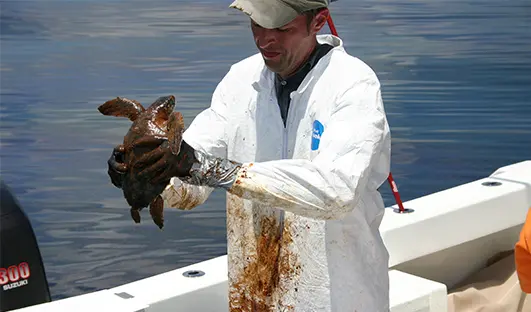
On April 20, 2010, the Deepwater Horizon drilling rig, operated by BP in the Gulf of Mexico, suffered a catastrophic blowout. The resulting explosion killed 11 workers and initiated the largest marine oil spill in history. For 87 days, an estimated 134 million gallons of oil gushed from the seafloor, nearly 5,000 feet below the surface.
Impact on Marine and Coastal Sediments
Unlike the Exxon Valdez, this was a three-dimensional crisis. Oil didn’t just float; it formed massive underwater plumes and eventually settled into the deep-sea sediments. The spill contaminated wetlands across five U.S. states. The volume of oily waste, a mixture of oil, sand, debris, and chemical dispersants, amounted to millions of tons, creating a logistical nightmare for waste management.
Remediation and Recovery Efforts
- Solidification and Stabilization (S/S): The sheer volume of waste forced an evolution in S/S technologies. Hundreds of thousands of tons of oily sand and sludge were excavated and treated.
- Chemical dispersants: This disaster also highlighted the limitations of chemical dispersants (like Corexit), which moved the pollution from the surface to the seafloor, emphasizing the need for mechanical recovery and permanent ex-situ oil sludge treatment.
Legal and Regulatory Evolution
The disaster led to the creation of the RESTORE Act, which directed 80% of administrative and civil penalties toward the ecological and economic restoration of the Gulf Coast. It also led to much more stringent oversight of offshore drilling safety and waste disposal protocols, ensuring that sludge created during drilling must be handled with the same rigor as the oil itself.
Reflection: The Inevitable Necessity of Effective Soil/Oil Sludge Treatment
The era of treating oil sludge as a hidden waste is over. Experience from the world’s greatest environmental challenges has shifted the industry’s focus from passive storage to active recovery, driven by four critical factors:

Complex Matrix
Oil sludge is a difficult mix of oil, water, heavy metals, and solids. Simple storage cannot stabilize this emulsion; it requires specialized separation technology to be truly safe.
Environmental Persistence
Petroleum hydrocarbons, especially heavy fractions (PAHs), do not disappear naturally. Without active treatment, they remain toxic in the soil and water for generations.
Indefinite Liability
Under modern laws like OPA 90 or China’s Soil Pollution Prevention Law, the environmental debt follows the producer forever. Leaving waste untreated creates a permanent financial risk.
Resource Recovery
Modern technology now allows us to turn waste back into value. Treating sludge at the source recovers usable oil and clean solids, turning an environmental burden into a circular economy advantage.
The Technological Response: Integrated Treatment Standards
The failures of the past, from the microbes killed by hot water in Alaska to the seafloor pollution in the Gulf, demonstrated that we cannot simply move oil; we must transform it. Today, the industry utilizes several proven methods to treat and recover oily sludge based on its specific composition::
Physical Separation
Mechanical Volume Reduction
- Definition: Using high-speed three-phase centrifuges to rapidly split oil sludge into oil, water, and solid phases through centrifugal force.
- Scope of application: Best for high-liquid waste (e.g., tank bottoms or lagoon pits). It is the first line of defense, reducing total waste volume by up to 80% to cut logistics costs.
Thermal Desorption
The Gold Standard for Recovery
- Definition: Thermal desorption is a non-oxidative thermal process that heats sludge to vaporize hydrocarbons without combustion. These vapors are then condensed to recover pyrolysis oil.
- Scope of application: The premier solution for complex oily solids. It is used when the output must meet the strictest standards (TPH < 0.3%) for safe soil reuse in construction or backfilling.
Bioremediation
Nature-Based Ecological Restoration
- Definition: The use of specialized microbial cocktails or plants to naturally digest and break down remaining low-level hydrocarbons.
- Scope of application: Ideal for large-scale, low-concentration soil contamination where mechanical or thermal treatment is not logistically or financially feasible.
Conclusion: Securing a Greener Future
The black tides of 1989 and 2010 redefined our relationship with the earth’s soil and water. They proved that the petrochemical industry cannot exist without a robust, scientifically-backed system for managing its waste. Effective oil sludge treatment is the last mile of the energy transition. Whether through high-tech thermal recovery or low-impact bioremediation, the goal remains the same: to ensure that the energy that powers our world does not destroy the ground beneath our feet.